The POS that eliminates operational chaos in F&B
How much revenue are you losing in every F&B service? Most hotels can’t answer that question. And that’s exactly the problem. It’s not a lack of demand or workload — it’s the absence of control over what is happening in the operation in real time.
Systems that don’t communicate with each other create duplication. Decisions based on intuition reduce margins. Manual processes generate errors. And information arrives late, in Excel files disconnected from operational reality. The result: teams work harder and earn less than they should.
01
The operational challenge
Hotel F&B operations generate a level of complexity that few systems are prepared to manage. Multiple outlets — restaurant, bar, terrace, pool, room service — different guest types, board plans, all-inclusive models, and room charges all coexist within the same shift. Without a POS specifically designed for this environment, every service becomes a source of errors, delays, and data loss.
Operational impact of fragmented systems
Time lost in recalculations
Non-actionable real-time data
02
Menu engineering: data that optimizes your menu
Do you know which dishes actually make you money — and which ones simply create noise? Menu engineering transforms intuition into measurable decisions. With Prestige POS, every menu item is automatically classified into four quadrants based on sales volume and contribution margin.
Menu Engineering Matrix — Automatic Classification by Prestige POS
⭐ STARS
High sales · High margin
Protect and promote. They are the profitable core of your menu.
🐴 PLOWHORSES
High sales · Low margin
Review pricing or reduce costs. High volume with improvable margins.
🧩 PUZZLES
Low sales · High margin
Reposition on the menu. Hidden potential that needs visibility.
🐕 DOGS
Low sales · Low margin
Remove or redesign. They take space without adding value.
Vertical axis: sales volume (high/low). Horizontal axis: contribution margin (high/low). Prestige POS calculates both dimensions in real time.
Most hotels do not have this data integrated into their daily operations. With Prestige POS, menu engineering stops being a theoretical exercise and becomes a real-time operational tool: every morning, the F&B Manager knows which dishes require action — without waiting for month-end reports.
03
Frictionless operations: speed + experience
Without smooth operations, there is no reliable data. Without reliable data, there are no good decisions. The first requirement of any hotel POS is to disappear from the team’s focus so that only the guest experience remains visible. Prestige POS is designed exactly for that.
Core features without friction
Split and merge orders with a single gesture
Move guests between areas without losing the order (“follow me”)
Workflow adapted to each outlet: restaurant, terrace, bar, pool, room service
Multiple outlets and terminals managed from a single control point
Shift management and terminal switching directly from the POS
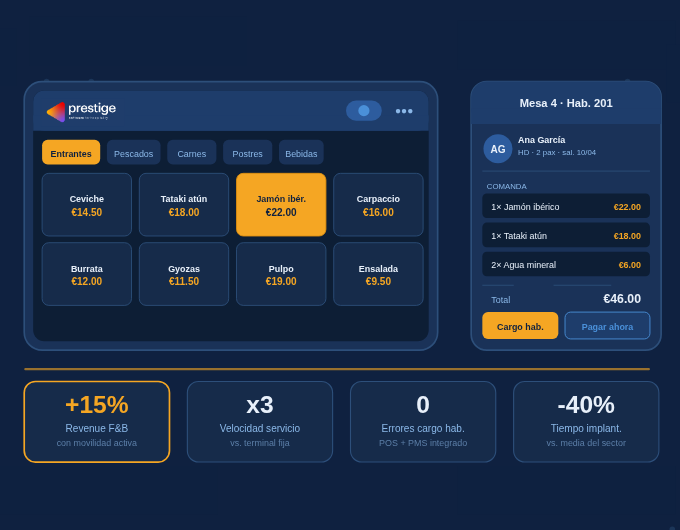
Mobility: the most visible change
More time with guests, less time at fixed terminals
Reduced service time and elimination of bottlenecks
Staff access guest profiles during service
Higher average ticket through contextual suggestions and natural upselling
Results with Prestige POS + mobility enabled
Reduction in service errors
Improved time between orders
Staff satisfaction (eNPS)
Key insight: Hotels using mobility with Prestige POS report a +15% improvement in F&B revenue and service speeds up to 3x faster compared to fixed-terminal operations.
04
POS + PMS integration: one single ecosystem
The industry’s biggest challenge remains fragmentation. Systems that don’t communicate, manual postings, and empty guest profiles at the point of sale. With Prestige, POS and PMS are part of the same ecosystem. Not an integration. Not an API connecting separate products. The same data core.
Automatic room charges
Charges are posted to the PMS in real time without manual intervention. No transcription errors. No revenue leakage.
Guest profile at the point of sale
When taking an order, staff instantly see: guest name, room number, board plan, arrival, departure, and pax — no searching, no unnecessary questions.
Unified payments
Cash, card, wristband, QR, personal device, and room charge processed within the same payment flow.
All-inclusive & resorts: zero leakage
Wristbands, day passes, minimum spend, and all-inclusive management handled within the same POS. Eliminates interdepartmental revenue loss and increases ancillary revenue.
Impact of POS + PMS integration on hotel operations
Reduction in room charge errors
Increase in ancillary revenue
Real-time data visibility
Data based on properties with native Prestige Software POS+PMS integration enabled. Results may vary depending on the type of operation.
05
From order to business intelligence
The goal is not to sell more. It’s to sell better. Every order, every consumption, every interaction becomes actionable business intelligence. Prestige POS automatically tracks which dishes sell best by outlet and time of day, guest consumption patterns, operational bottlenecks, and combinations that maximize average ticket value.
Real-time metrics available
Sales by outlet: restaurant, bar, terrace, pool, room service
Sales by time slot: breakfast, lunch, dinner, aperitif
Average ticket by guest type: FIT, group, all-inclusive
Contribution margin per dish cross-referenced with ingredient costs
Table turnover: average time per cover and service
Upselling rate: % of orders accepting suggestions
Business impact
Menu redesign based on data, not intuition
Dynamic pricing adjustments by demand and time slot
Staffing optimization through demand prediction
Identification of low-profitability areas
Automated reporting for management and ownership
Decisions made in minutes, not days
06
Fast implementation: starting right from day one
Many technology projects don’t fail because of the product — they fail because of implementation. Prestige has developed a standardized deployment model proven across multiple properties. After more than 30 years of experience and presence in over 21 countries, the process is designed to minimize hotel risk and maximize time-to-value.
Comparativa de implantación: Prestige POS vs. media del sector
| Parameter |
Industry average |
Prestige POS |
| Implementation time |
8–12 weeks |
2–3 weeks |
| Team training |
5–7 days |
1–2 days |
| First stable service |
Week 6–8 |
Day 1 |
| Post-launch support |
Ticketing |
Dedicated team |
| Operational risk |
High |
Minimal |
“A POS shouldn’t just manage orders. It should help answer one essential question: Am I operating efficiently — and am I making money doing it? With Prestige, that answer stops being a guess. It becomes clear, measurable, and actionable.“