



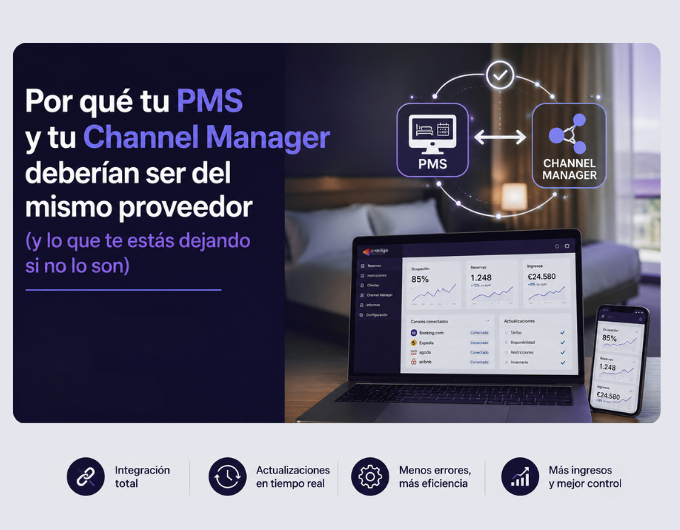
PMS and Channel Manager from the same provider: 7 real advantages for your hotel
Why native integration between PMS and Channel Manager matters more than ever
Between 60% and 85% of a typical hotel’s business now comes through digital channels: OTAs , its own booking engine, metasearch engines, and online travel agencies. Direct sales at the front desk are the exception.
If the bulk of the business is online, why is the PMS still the last to know? When the PMS and Channel Manager are from different providers, information travels with a delay, is simplified, and sometimes even lost. Front desk staff improvise, finance estimates, and management makes decisions based on outdated data. Native integration breaks this cycle: online sales cease to be an external input and begin to feed the entire hotel’s operations in real time.
If the bulk of the business is online, why is the PMS still the last to know? When the PMS and Channel Manager are from different providers, information travels with a delay, is simplified, and sometimes even lost. Front desk staff improvise, finance estimates, and management makes decisions based on outdated data. Native integration breaks this cycle: online sales cease to be an external input and begin to feed the entire hotel’s operations in real time.
7 advantages of having PMS and Channel Manager from the same provider
1. Complete packages to PMS engine, without manual work
A package including room, dinner, and spa access should arrive at reception with each component assigned to its corresponding cost center. With a natively integrated ecosystem, the package travels as a whole from the booking engine to the PMS , and if distributed through OTAs , it also passes cleanly through the Channel Manager . Without native integration, it typically arrives fragmented or as a generic booking with a single total amount, requiring manual reassembly.
2. No-shows reported to Booking automatically (and lower commissions)
When a guest doesn’t show up and the booking originated from Booking.com, the hotel has the right to report the no-show so the commission can be adjusted or canceled. However, someone has to do this manually in the extranet, so it’s either done late or not at all. With Prestige PMS and Prestige Channel Manager , the PMS detects the no-show and the Channel Manager reports it to Booking.com without human intervention: fewer reception hours and fewer overpaid commissions.
3. Invalid credit cards processed without touching reception
Booking detects an invalid card, notifies the hotel, and someone has to contact the customer, obtain a new card, and update the reservation. In an integrated ecosystem, this workflow is triggered automatically: communication with the customer, an update in the PMS , and, if the card isn’t resolved, cancellation according to the hotel’s policy. All without picking up the phone.
4. Actual, not approximate, financial statistics
When a package enters the PMS , each component—accommodation, F&B, extras—must be accounted for in its corresponding cost center. If this breakdown isn’t automated, the controller ends up distributing amounts in Excel, and the dashboards remain at a level of approximation. With native integration, the data arrives already broken down, and the controller shifts from reconciling to analyzing.
5. One supplier, one responsibility at hand
With two providers, issues end up in a back-and-forth: “It’s the PMS’s problem”… “No, it’s the Channel’s.” With a single provider, the ticket triangulation disappears: a single team understands both systems and resolves issues end-to-end. Less operational friction for the hotel manager and lower vendor management costs for the chain’s CIO.
6. Zero duplicate data entry in PMS and Channel Managerel Manager
Rates, restrictions, policies, descriptions, packages, surcharges: every piece of data that resides in two systems is a potential source of error. With a shared database, the revenue manager changes a rate and the change is instantly reflected across the booking engine, channel, and all connected OTAs.
7. Real-time inventory and availability, without commitmentsos
Connecting Prestige’s PMS to an external Channel Manager (e.g., SiteMinder) is possible and works: rates and availability are transmitted correctly. But everything that came before—automatic no-shows, self-managed cards, segmented packages, single support—no longer exists. The real question isn’t “Can it be connected?”, but “What do I lose if I don’t integrate it natively?”
Technical decision or strategic decision?
The choice between an integrated PMS and a separate Channel Manager is, in reality, a decision about the operating model: do you want a front desk team running the hotel, or just acting as a glue between systems? Every minute spent reconciling reservations or reporting no-shows is a minute not spent with the customer. And in hospitality, customer service isn’t a nice-to-have: it’s the product.
Conclusion: a single ecosystem for selling, operating, and collecting payments
The future of the PMS is not just another piece of the hotel’s technological puzzle, but the operational brain that connects everything the hotel offers: accommodation, food and beverage, spa, events, and additional services. That’s why at Prestige Software we built Prestige PMS , Prestige Channel Manager , Prestige Booking Engine , and Prestige Pay as a single ecosystem, not as four separate products. The difference isn’t visible in the demo; it’s visible in the bottom line.
Are you reviewing your technology stack for 2026?
Let’s talk. We’ll show you how we’re doing it with independent hotels and chains in Spain and Europe.
About the author — Editorial team at Prestige Software , a company specializing in hotel technology. More thoughts on PMS, AI, and operations on LinkedIn .